What Are Calories?
Food contains energy. The amount of energy inside food is measured in calories.
Per 1 gram:
- Carbohydrates contain 4.5 calories/gram
- Protein contains 4.5 calories/gram
- Fats contain 9 calories/gram
Our body burns calories to produce energy.
Basal Metabolic Rate
How many calories your body burns per day by simply existing and performing life-sustaining function is called your Basal Metabolic Rate.
These functions include all the involuntary processes in your body, such as breathing, digesting food, pumping blood, brain activity, and much more.
Your basal metabolic rate excludes energy burnt through exercise or energy acquired from eating food.
Total Daily Caloric Expenditure
Your total calorie expenditure is how many calories you burn per day (including your BMR, calories obtained from food and calories lost from exercise).
Use our free calorie calculator to work out how many calories you burn per day.
Calories In Versus Calories Out
Caloric Surplus – where the number of calories that we consume is higher than the number of calories we burn. The surplus calories our body doesn’t use is stored as body fat (adipose tissue).
Body fat is stored energy.
In a caloric surplus, our body mass increases.
Caloric Maintenance – when the number of calories that we consume is the same as the number of calories we burn. Our body mass will stay the same.
Caloric Deficit – where we burn more calories than we consume. As a result, our body has to break down fat tissue to release stored energy to meet our energy demands.
Caloric Deficit To Promote Fat Loss
To ensure fat loss, we must be in a state of caloric deficit. We can achieve a caloric deficit by:
- Reducing caloric intake from food
- Exercising regularly to increase how many calories you burn
- Combination of caloric restriction and regular exercise
Reduce Caloric Intake From Food
Eat At A Small Caloric Deficit
Eating at a small caloric deficit of 200 to 500 calories can ensure sustainable fat loss without loss of muscle mass.
However, eating at a larger caloric deficit can also result in loss of muscle mass alongside fat loss – which will overall lead to a worse body composition.
Additionally, a large caloric deficit can slow down metabolism, reducing your overall basal metabolic rate and how many calories you burn.
Eat Adequate Protein
To prevent loss of muscle mass during a caloric deficit, it is paramount to eat 1.6 to 2 grams of protein per kg of body weight and to regularly practice resistance training.
Reverse Dieting
To prevent fat loss slowing down during a caloric deficit, we can utilize Reverse Dieting:
- Gradually reducing the calories we consume from maintenance (e.g, by 100 calories a week until we reach 500 calories per day caloric deficit)
- Gradually increasing the calories we consume back to maintenance level (by 100 calories a week until we reach maintenance, to prevent rebound fat gain).
Increase Calories Burnt From Exercise
By exercising more regularly, we can burn more calories per day.
The most effective forms of exercise are: resistance training, LISS (Low Intensity Steady State) exercise like waking, and HIIT cardio.
Resistance Training

Working out 3 to 5 times per week using body weight training or lifting weights with a large focus on compound exercises like pull ups, push ups, squats, deadlift, bench press, dips and L sits.
Compound exercises burn significantly more calories than isolation exercises which train only 1 muscle group such as bicep curls and abdominal crunches.
Additionally, working out promotes protein synthesis and muscle hypertrophy (building muscle).
Increasing your muscle mass increases your basal metabolic rate. The more muscle mass you have, the more calories you burn per day and the faster your metabolism.
Walking

An hour walk burns between 210 and 360 calories for most people.
At a casual pace you will cover 3 miles in an hour walk. Doing an hour walk 5 days of the week will burn an extra 1,050 to 1,800 calories.
If your diet remains the same, this increased exercise could lead to ⅓ to ½ a pound of fat loss a week.
The key benefit of walking is everyone can do it, and it is very easy to implement into your life style and can be done everyday.
Unlike HIIT (High Intensity Interval Training), walking doesn’t lead to DOMS (Delayed Onset Muscle Soreness)
I recommend building up to 10,000 steps per day of walking. I personally walk 10,000 to 15,000 steps per day, which helps me burn anywhere from 400 to 550 calories.
The best time to walk is after a meal.
HIIT Training (High Intensity Interval Training)

HIIT (High Intensity Interval Training) are short and intense cardiovascular workouts.
Examples of HIIT include:
- Sprinting
- Alternating Between Sprinting And Jogging
- Cycling on Stationary Bike at Maximum Speed
- Rope Jumping
- Basketball
Utilizing training HIIT (High Intensity Interval Training) will:
- Preserve Muscle
- Boost Metabolism
- Increase Fat Loss
- Save Time
Preserves Muscle
Unlike traditional steady state cardio like jogging (which makes us lose muscle), HIIT can preserve muscle mass and increase protein synthesis.
HIIT training utilizes both aerobic and anaerobic training.
Aerobic training increases your body’s demand for oxygen, improving endurance and stamina, while anaerobic training builds and maintains muscle mass.
Studies have shown that HIIT increases HGH (Human Growth Hormone) by 450% 24 hours after a HIIT workout
HGH increases recovery and muscle repair from workouts, and encourages the body to build and maintain lean muscle mass.
Boosts Metabolism And Fat Loss
Intense exercise and HIIT training increases the body’s demand of oxygen during exercise, and 24 to 48 hours after.
This is called the “afterburn” effect (or EPOC).
The more oxygen your body uses, the more fat it burns.
As a result, HIIT increases your metabolism for 24 to 48 hours after exercise.
Saves Time
Studies show three 20 minute HIIT sessions burns the same amount of calories as five 60 minutes sessions of traditional steady state cardio (such as jogging).
Frequently Asked Questions About Fat Loss
How Many Calories Do I Need To Lose Fat?
Using our calorie calculator, work out your maintenance calories.
How Long Does It Take To Lose 1 Pound Of Body Fat?
1 pound contains 3,500 calories.
If you are at a caloric deficit of 500 calories per day, it will take you 7 days to burn 1 pound of body fat. This is a 0.5% decrease in body fat per week.
How Long Does It Take To Lose 1 Kilogram of Body Fat?
1 kilogram of body fat contains 7700 calories.
Depending on your caloric deficit, it will take you:
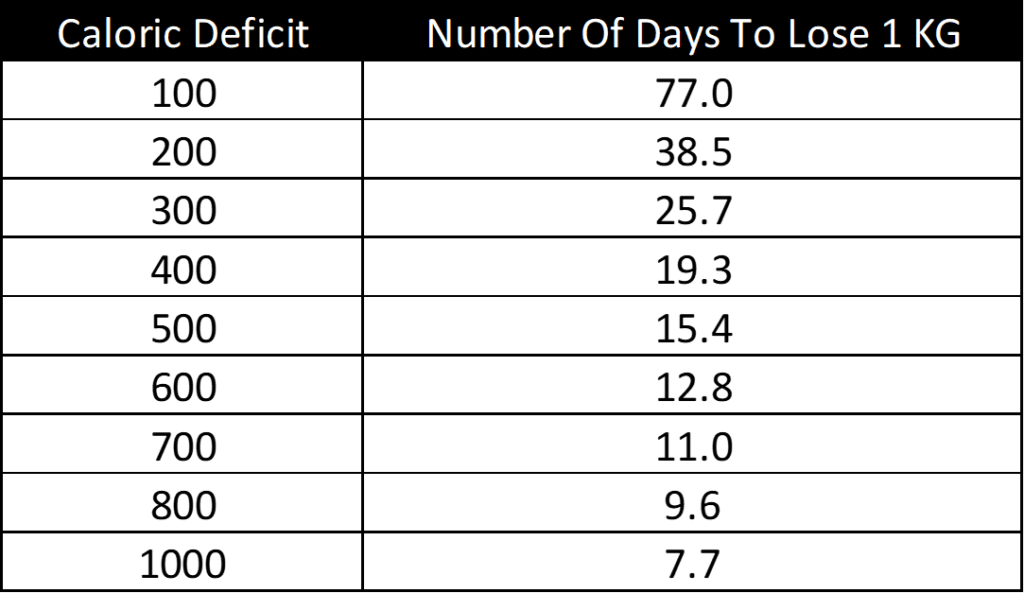
If you are at a caloric deficit of 500 calories, it will take you 7700/500 = 15.4 days to lose 1 kg of body fat.
The smaller your caloric deficit, the longer it will take to lose 1KG of body fat.
The higher your deficit, the faster you will lose body fat. However, a caloric deficit larger than 500 calories will be harder to sustain and could make you lose muscle mass alongside body fat.
Stick to a caloric deficit of 200 to 500 calories per day.
At What Body Fat Percentage Can I See My Abs?
For men, you can see your abs once you reach under 15% body fat.
How Long Will It Take To Get 6 Pack Abs?
This depends on your current body fat percentage.
If you are 25% body fat, you need to get to 15% body fat to see your abs.
This means you need to lose 10% body fat.
Stick to a caloric deficit of 500 calories per day, you are losing 1 pound of body fat per week. This is also a – 0.5% decrease in body fat per week.
That means it will take you 2 weeks to lose 1% body fat.
Overall, 20 weeks to lose 10% body fat and see your abs.
Use the following chart below to calculate how many weeks it will take you to get 6 pack abs:

What Is The Optimal Body Fat Percentage To Maximize Testosterone Production?
10% to 22% body fat is the optimal body fat to maximise health & testosterone in men (NCBI, 2012).
Smaller waist size is linked to higher testosterone (NCBI, 2008). Excess body fat is linked to low testosterone (NCBI, 2014). Obese men have 50% less testosterone than lean men (NCBI, 2014).
- Fat cells increase inflammation & increase insulin resistance (cause of low testosterone) (NCBI, 2014).
- Fat cells increase conversion of testosterone to estrogen via the aromatase enzyme – reducing total testosterone & increasing estrogen (NCBI, 2014)
- High estrogen increases body fat, water retention, risk of gynecomastia & suppress testosterone production (NCBI, 2014)
- High body fat increases the stress hormone cortisol: reducing testosterone, increasing catabolism (muscle break down) & slowing metabolism (NCBI, 2021).
Being too lean (under 10% body fat) reduces testosterone, sperm count, muscle strength, decreases energy, impairs work out recovery & can increase risk of cardiac issues (Men’s Journal, 2021)
How Many Grams Of Protein Per Day To Maintain Muscle Mass While Losing Fat?
You need to eat 1.6 to 2.2 grams of protein per kilogram of body weight per day to maintain muscle mass and build muscle during fat loss.
This means if you are 70kg, you need between 112 to 154 grams of protein per day.
You can use the table below to see your minimum and maximum protein intake per day based on your bodyweight in kilograms: